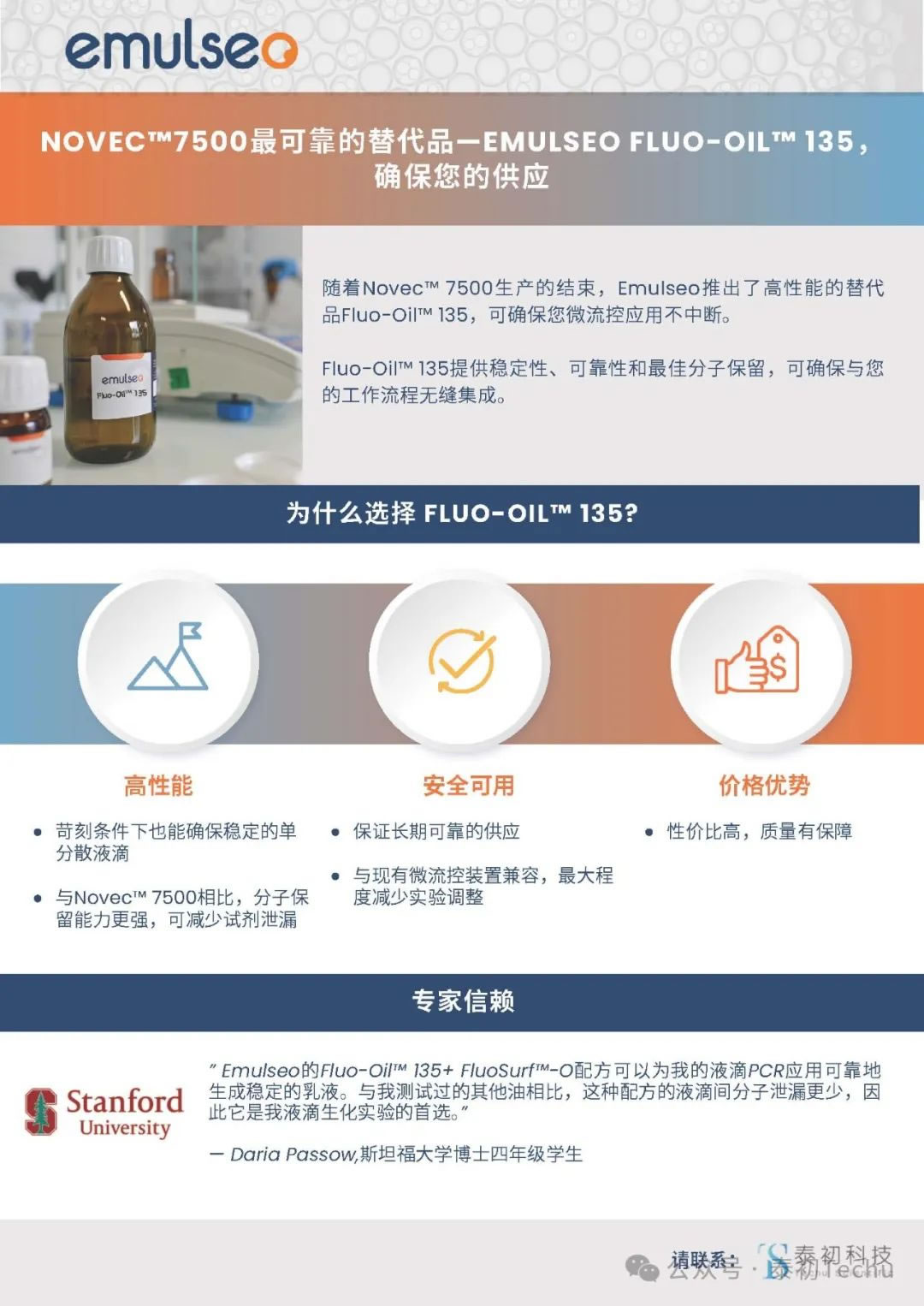


Fluo-Oil 135 (abbreviated as FO135) is a fluorinated oil with good biocompatibility, which can be used as a replacement for 3M Novec HFE7500 engineered fluid.
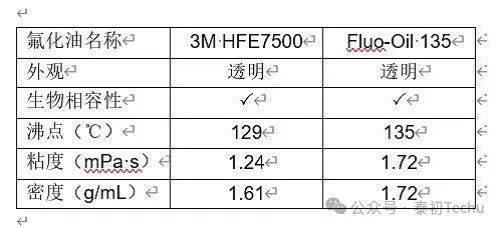

Advantage
Biocompatibility, reproducibility, and stability.
How to use?
Fluo-Oil 135 can be used to dilute FluoSurf Neat surfactant, or FluoSurf surfactant that has already been diluted with Fluo-Oil 135.
(FluoSurf Neat is a complex, highly efficient surfactant with a PFPE-PEG structure. Similar surfactants – such as other PFPE-PEG-based agents, including FluoSurf Neat, Surf-Drop, PFPE-PEG-PFPE diblock or triblock surfactants, and various fluorinated surfactants – can generally be diluted using the fluorinated oil Fluo-Oil 135. The typical dilution range is bewteen 0.2% and 12%.)
Storage
Store at room temperature, protected from sun light.
Safety Precautions
● Avoid inhalation, ingestion, and contact with skin or eyes.
● Wear chemical-resistant personal protective equipment (PPE).
● Wear appropriate gloves and suitable protective clothing.
● Wear safety glasses with side shields.
Comparison of droplet generation performance: FO135 versus 3M Novec HFE7500
FluoSurf neat surfactant was diluted with either 3M Novec HFE7500 or Fluo-Oil 135 to achieve a mass concentration of 4%(w/w).
Two-phase flow rates for the genration of aqueous droplets (water-in-oil droplets):
The flow rate of the oil phase is 300 μL/hr, and the flow rate of the aqueous phase is 100 μL/min.
The aqueous phase consists of either a PBS solution or a 100 μM fluorescein solution in PBS (used to test for droplet leakage).
Observations were performed using an inverted microscope, and data were analyzed with ImageJ software.
I. Droplet Size and Its Distribution
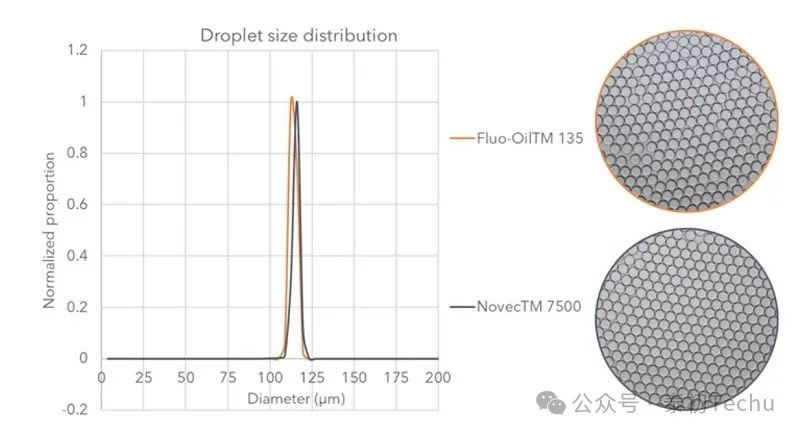
Water droplets of similar size were produced using Fluo-Oil 135 and HFE-7500 oil respectively. Under the given flow rate parameters, the average diameter of the droplets is 110 μm. The CVs for droplet size were 2.3% (Fluo-Oil 135 oil) and 2.9% (HFE7500 oil).
2. Droplet stability
Most research groups use droplet microfluidics for cell encapsulation or PCR applications. Therefore, heating cycles of PCR and long-term incubation at 37°C are required to generate stable droplets. Surfactant selection is critical, but oil selection is equally important to ensure reproducible experiments, the generation and preservation of monodisperse droplet populations.
The stability of the droplets was tested from three aspects: first, the droplets were re-injected into the glass observation chamber; second, the classic PCR thermal cycle process, 30 times, each thermal cycle was 98°C for 10 seconds, 50°C for 5 seconds, and 72°C for 10 seconds; third, placed in an incubator at 37°C for 3 days. 10,000 droplets were analyzed.
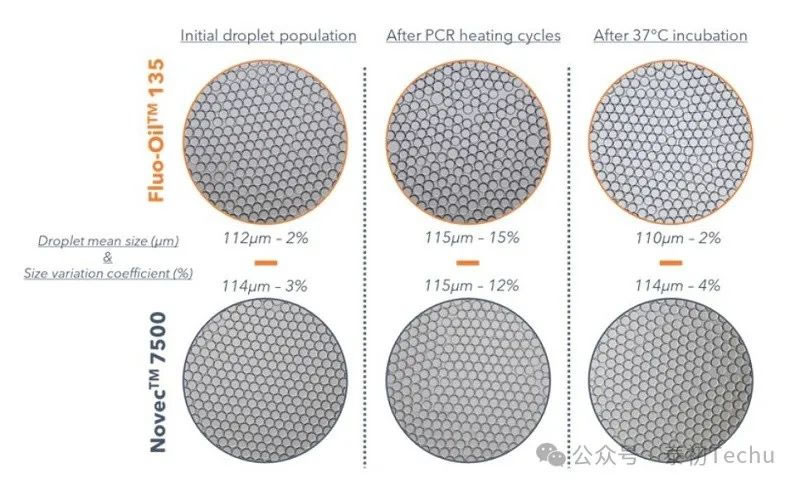
Whether using Novec™ HFE 7500 or Fluo-Oil™ 135 to form droplets stabilized by FluoSurf™, the average droplet size—approximately 110 μm (0.7 nL)—remains unchanged after PCR thermal cycling or following a 3-day incubation at 37°C. Furthermore, the droplet population remains monodisperse. Statistical analysis indicates that, after thermal cycling, only 5% of the total droplet population deviates from the mean initial diameter by more than 10%.
Switching the fluorinated oil from Novec™ HFE 7500 to Fluo-Oil™ 135 has no impact on droplet stability.
III. Molecular Retention Within Droplets
Droplet-based chemical or biochemical analyses rely on reagents remaining isolated in individual droplets. Any leakage into the continuous phase—or exchange between droplets—can compromise the integrity of the results, even at low levels. Consequently, molecular retention is a critical parameter to consider when selecting a fluorinated oil. Since fluorinated oils are known to limit molecular exchange between droplets, it is essential to verify the effects of switching from one oil to another.
Two types of water-in-oil emulsions—”empty” (containing PBS) and “full” (containing fluorescein)—were generated using either Novec™ HFE 7500 or Fluo-Oil™ 135 as the continuous phase. The resulting mixtures, each containing both populations, were incubated at 37°C and imaged at various time points. The evolution of fluorescence intensity within the droplets was then quantitatively analyzed using ImageJ software.
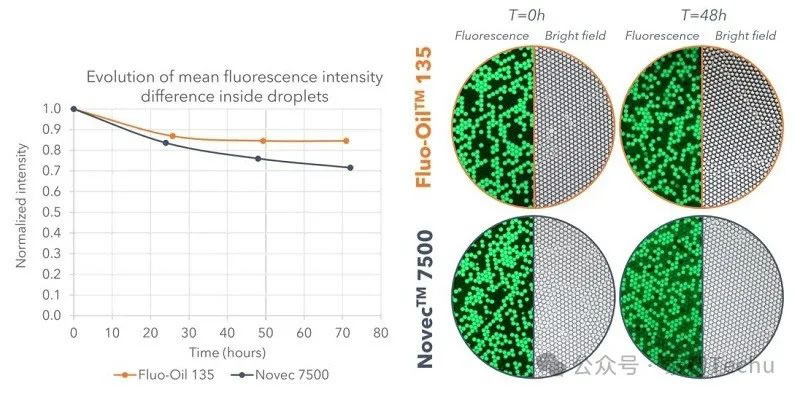
The figure above shows the evolution of the difference in mean fluorescence intensity between two groups (dye-loaded droplets and empty droplets), along with corresponding fluorescence and bright-field images taken at the initial time point and after 48 hours.
Over a 24-hour period, the leakage rate of fluorescein from droplets generated using either fluorinated oil was similar (approximately 15% leakage). In the case of droplets generated using Fluo-Oil™ 135, this rate remained constant for 3 days. In contrast, for droplets in Novec™ HFE7500, leakage continued to increase after 24 hours, reaching approximately 30%. This poorer retention over longer incubation periods can be attributed to the slightly lower viscosity of the latter oil, which facilitates faster molecular exchange between droplets.
Conclusion
For droplet-based microfluidic applications, switching from one type of fluorinated oil to another can significantly impact the experimental process — particularly the efficient generation of droplets. It has been demonstrated that substituting 3M Novec™ HFE7500 Engineered Fluid with Fluo-Oil™ 135 has no adverse effect on experimental conditions or results. In fact, when Fluo-Oil™ 135 is used as the continuous phase, even better retention of fluorescein within the droplets can be observed.
Fluo-Oil™ 135 serves as an effective alternative to 3M Novec™ HFE7500 for droplet-based microfluidic applications.