


Fluo-ST3 is a hydrophobic surface treatment agent consisting of a fluoroalkylsilane dissolved in a perfluoropolyether solvent.
Fluo-ST3 is a transparent solution characterized by low viscosity and low interfacial tension. When applied to a surface, it forms a uniform, covalently bonded thin layer, rendering the surface—or the walls of microchannels—both hydrophobic and fluorophilic. This treatment facilitates the generation of droplet-based microspheres and enhances the stability of droplets within fluorinated oils.
Fluo-ST3 is suitable for use with emulsifiers, fluorinated surfactants, and various common droplet generation oils.

Advantages

Comparison of Fluo-ST Series Hydrophobic Reagents
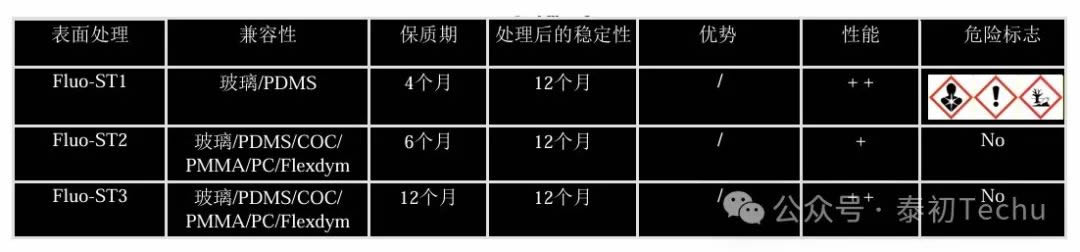
Fluo-ST3 Storage Conditions
Fluo-ST3 hydrophobic surface treatment reagent can be stored at room temperature for one year without any loss in performance.
Chips treated with Fluo-ST3 can be stored at room temperature for one year without any loss in performance.
Steps:
1. Clean the chip with isopropanol.
2. Fill the chip channels with Fluo-ST3, leave for 30 seconds and flush the excess.
3. Rinse the channels with a fluorinated oil.
4. Begin your experiment.
Note:
1. If heat treatment is required, it is recommended to place in an oven at 65°C for a duration ranging from 30 minutes to 2 hours.
2. Filter the Fluo-ST3 using a 0.22 μm hydrophobic PTFE filter (it is recommended to use the same filter no more than twice). This step helps to further remove any crystalline particles in the micrometer size range present within the Fluo-ST3.
Tests
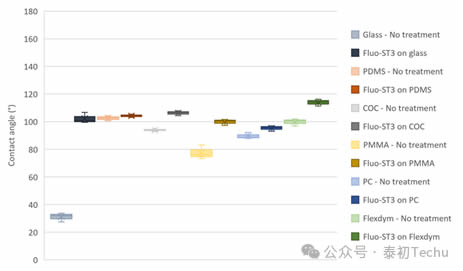
Regardless of the material being tested, surface treatment can enhance hydrophobicity. It serves as a perfect alternative to Aquapel (Autoserv, Germany) for rendering surfaces—such as PDMS, silicon wafers, and glass—hydrophobic.
For an example of a PDMS microfluidic chip:
Microfluidic devices were fabricated using polydimethylsiloxane (PDMS) via standard soft lithography. An SU-8 photoresist mold was prepared by exposing a silicon wafer to ultraviolet (UV) light through a photomask. A curing agent was added to the PDMS base (Sylgard 184 silicone elastomer kit) to a final concentration of 10% (w/w), mixed thoroughly, and poured onto the mold. After degassing for several minutes and cross-linking at 75°C for one hour, the PDMS was peeled from the mold. Inlet and outlet ports were then created in the PDMS slab using a 0.75 mm diameter hole punch. PDMS debris was removed from the ports using clear adhesive tape, followed by rinsing with isopropanol and drying with pressurized nitrogen gas. The patterned side of the PDMS slab was bonded to a 75 × 50 × 1.2 mm glass microscope slide (Corning) by exposing both surfaces to oxygen plasma and pressing them together. Finally, a Fluo-ST3 hydrophobic solution purchased from Techu Scientific (Tianjin) Co., Ltd. was injected into the PDMS device to form a thin hydrophobic coating on the walls of the microfluidic channels. For conductive microfluidic chips, the PDMS device was bonded via plasma treatment to the non-conductive side of a 75 × 50 × 1.1 mm indium tin oxide (ITO) glass slide, with the conductive side of the ITO glass serving as a counter electrode. Electrodes were integrated into the system by filling the entire microchannel network with a low-melting-point solder (an indium-tin alloy).
Suggestions:
When treating PDMS chips with hydrophobic reagents Fluo-ST3, you can concentrate your time on processing 10-30 chips at a time and reserve them for later use. Doing this can save a lot of time while ensuring the consistency of the PDMS devices used.
Current packaging format: 8 mL/bottle (standard).
The brochure of Fluo-ST3 hydrophobic reagent, please click Here to download and view. Here

PDMS Flow-Focusing Droplet Chip

T-Shape Droplet Glass Chip
Observation of a PDMS flow-focusing droplet chip under an inverted microscope following treatment with the Fluo-ST3 hydrophobic agent